Replay Guide — @newkrok/nape-js/replay
Record a deterministic simulation, store it as a compact binary blob, and play it back later — same machine, another machine, days later. Useful for:
- Bug reproduction — capture a misbehaving session, share the blob, replay it locally with a debugger attached.
- Multiplayer rollback foundation — server records authoritative inputs, clients replay-with-prediction.
- Shareable replays — post a base64'd replay URL; anyone can load and watch it.
- Regression tests — store a replay, assert that simulation X always produces position Y.
The library is intentionally a thin layer over /serialization plus
space.deterministic = true. It owns the snapshot + input-log plumbing; you
own the applyInput callback.
Architecture
┌─ Recorder<T> ───────────────────────┐    ┌─ Replay<T> ────────────┐
│  initial = spaceToBinary(space) ────┼──▶ │ initialSnapshot        │
│  recordFrame(input) per frame ──────┼──▶ │ inputs[]               │
│  keyframeEvery: 60 (optional) ──────┼──▶ │ keyframes[]            │
└─────────────────────────────────────┘    │ frameCount             │
                                           └──┬─────────────────────┘
                                              │ encodeReplay
                                              ▼ Uint8Array (binary blob)
                                              │ decodeReplay
                                              ▼
┌─ Player<T> ──────────────────────────┐
│  space = spaceFromBinary(initial)    │
│  step(): applyInput + space.step()   │
│  stepTo(frame): scrub via keyframes  │
└──────────────────────────────────────┘
Core principle: inputs in, simulation out
The library does NOT patch body.applyImpulse or any other Space mutator.
Instead, you provide an applyInput callback that the player calls once per
frame, BEFORE stepping. The callback turns a recorded payload into the same
Space mutations you'd make during a live session.
This is the right boundary:
- Engine determinism is the engine's responsibility (
space.deterministic = truealready gives same-platform bit-equivalence). - Logic determinism is your responsibility — the callback must be pure.
- The library is the thin glue: snapshot, input log, frame counter.
Recording
import "@newkrok/nape-js";
import { Recorder } from "@newkrok/nape-js/replay";

type Input = { jump?: boolean; mouseX?: number; mouseY?: number };

space.deterministic = true; // mandatory — without this, replays drift

const recorder = new Recorder<Input>(space, { keyframeEvery: 60 });

for (let frame = 0; frame < 600; frame++) {
  const input = readUserInput();    // your code — may be null

  recorder.recordFrame(input);       // logs the payload at the current frame
  applyInput(input, space, frame);   // your own logic
  space.step(1 / 60);
}

const replay = recorder.finish();    // immutable Replay<Input>
Key constraints during recording:
space.deterministic = truemust be set BEFOREnew Recorder(space). The flag is captured into the initial snapshot and restored on playback.- The recording space MUST keep stepping the same instance — keyframes are sampled from it.
- Stick to a fixed
dtand iteration counts. ThePlayerdefaults todt = 1/60,velocityIterations = 8,positionIterations = 3. Pass matching values via the player's options if you used different ones. applyInputmust be a pure function of(input, space, frame)— noMath.random(), noDate.now(), no global mutation, no reading frombody.userData(binary serialization skips it).
keyframeEvery
Each keyframe is a full snapshot — sized like the initial one (~150-300 bytes
per body). With keyframeEvery: 60 and a 30-second replay containing 100
bodies, that's roughly 30 keyframes × 100 bodies × 200 bytes ≈ 600 KB of
keyframe data. Disable with keyframeEvery: 0 if you don't need scrub and
want the smallest possible blob.
Encoding & sharing
import { encodeReplay, decodeReplay } from "@newkrok/nape-js/replay";

const bytes = encodeReplay(replay);   // Uint8Array

// Persist to disk, send over WebSocket, embed in a URL, ...
const restored = decodeReplay<Input>(bytes);
The binary format is versioned (magic RPLY, version u16); decoding throws
on mismatch. Inputs are JSON-encoded as UTF-8 — keep payloads to plain
JSON-serialisable types (numbers, strings, booleans, plain objects, arrays). If
you need binary in a payload, base64-encode it into a string.
Playback
import { Player } from "@newkrok/nape-js/replay";

const player = new Player<Input>(replay, (input, space, frame) => {
  // Same logic as during recording — translate input → space mutations.
  if (input.jump) findPlayer(space).applyImpulse(new Vec2(0, -200));
});

const space = player.restore();      // Space deserialised from snapshot
while (!player.finished) player.step();
The player's space is a fresh Space it owns; the library never reuses
your recording space.
Random-access scrub
player.stepTo(60 * 5);   // jump to 5 seconds in
player.stepTo(60 * 2);   // jump back to 2 seconds — uses keyframes
Forward scrub steps through the input log. Backward scrub restores the latest keyframe ≤ target, then steps forward. Without keyframes, backward scrub re-restores from frame 0 and walks forward — still correct, just O(target).
Loop / restart
player.restore(); // idempotent — rewinds to frame 0
What's NOT preserved
body.userData— binary serialization skips it (it's not size-bounded). If you need to round-trip userData, encode it into your input payload, or usespaceToJSONdirectly (and accept the size cost).- Sleeping state — bodies wake fresh on snapshot restore. The simulation re-resolves sleep on the next step.
UserConstraintinstances — not serialisable; recordings using them fail to restore correctly.- Listeners / callbacks — not part of the snapshot. If your replay relies
on
InteractionListenercallbacks, attach them BEFORE you restore (e.g. in the same code that creates the listener types).
Determinism contract
Replay reproduces the recording bit-close when ALL of these hold:
- Same platform — same OS, same CPU architecture (x86-64 ↔ x86-64, ARM64 ↔ ARM64). Cross-platform requires fixed-point math (roadmap P74).
space.deterministic = true— set on the recording space.- Fixed
dt— both sides step with the samedtand iteration counts. - Pure
applyInput—(input, space, frame)→ mutations only. No ambient nondeterminism. - Matching engine version —
BINARY_SNAPSHOT_VERSIONis bumped on breaking layout changes; replays don't load across major engine versions.
Validating config
import { validateDeterministicConfig } from "@newkrok/nape-js/replay";

const { ok, warnings } = validateDeterministicConfig(space);
if (!ok) console.warn("Replay may drift:", warnings);
Currently checks space.deterministic. The function is a tiny pure
inspection — extend it as you discover more failure modes in your codebase.
Sizing & performance
| Replay length | 30 bodies, no keyframes | 30 bodies, keyframeEvery: 60 |
|---|---|---|
| 10 sec (600 frames) | ~5 KB | ~55 KB |
| 60 sec (3600 frames) | ~5 KB | ~310 KB |
| 5 min (18000 frames) | ~5 KB | ~1.5 MB |
(Approximate — input log size depends on your payload shape.)
For multiplayer rollback netcode, you typically want very small keyframeEvery
(or 0) and short replays — most rollback windows are < 200 ms.
Multiplayer rollback (foundation only)
P69 is the building block for rollback netcode, not a complete implementation. A typical setup:
- Server records authoritative inputs as
Recorder<NetInput>. - Server sends
encodeReplay(replay)snapshots periodically + diff inputs. - Client uses a local
Playerto predict ahead, then re-syncs on server state bystepTo(serverFrame)and re-applying any local pending inputs.
A higher-level @newkrok/nape-mp (or similar) package on top of this would
make sense as a future addition; the primitives shipped here cover the core
record/restore/replay loop.
Demos
Two demos in the examples grid exercise this API:
- Save / Load / Rewind (
save-load-rewind) — uses the underlyingspaceToBinarydirectly with a 3-second ring buffer for time-scrub. The P71 prototype that fed the P69 design. - Deterministic Replay (
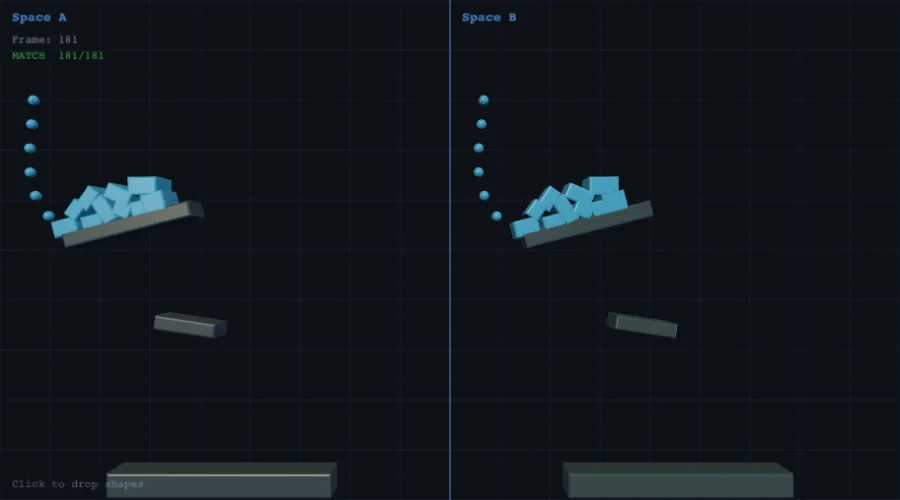
replay-recorder) — full Recorder + Player flow. Click to throw balls, Stop, then Replay — identical physics every time.
Related demos
Interactive demos that exercise what this guide covers.